“Should we put our budget into SEO or PPC?” It is one of the most common questions we hear from marketing managers, usually when a budget is under review or a board wants to see results faster.
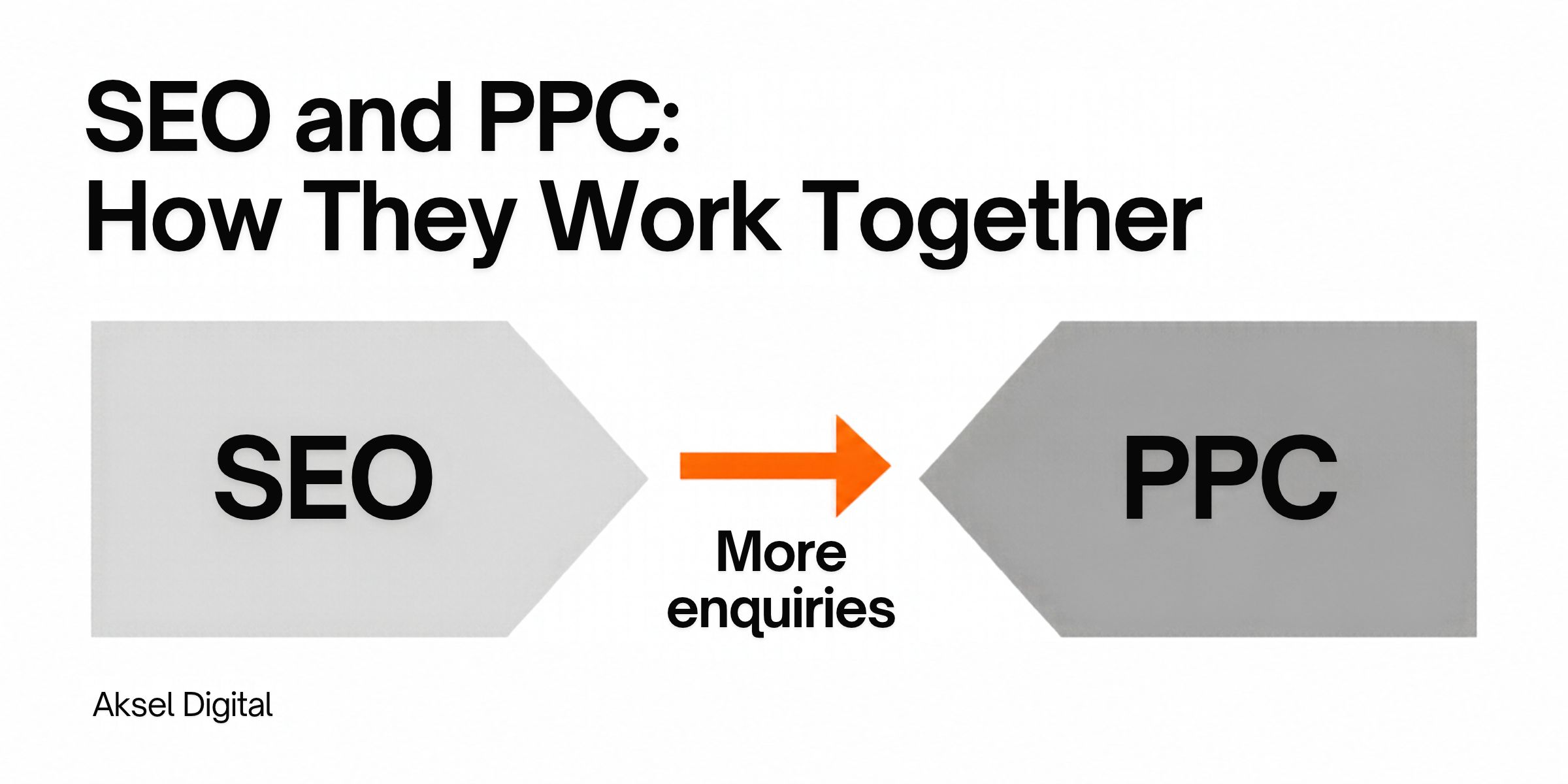
The honest answer is that it is rarely a choice between the two. SEO and PPC do different jobs, on different timelines, and they are at their strongest when they share data and support each other.
In this guide, we explain what each one does, how they differ, which to prioritise, how to split your budget, where social media fits, how to measure results, and how to run them together so your budget works harder.
What are SEO and PPC?
Both aim to get your business in front of people searching on Google. The difference is how you earn that position.
SEO (search engine optimisation) is the work that helps your website appear in the unpaid, organic results. It covers the technical health of your site, the content on your pages, and the authority your website builds through links and mentions from other sites. You do not pay per click, but you do invest time and expertise, and results build gradually.
PPC (pay per click) is paid advertising, most commonly through Google Ads. You bid to appear for chosen search terms and pay each time someone clicks your ad. The term also covers paid social on platforms like Meta and LinkedIn. Results can start within days, but traffic stops as soon as the budget does.
A simple way to think about it: PPC is like renting a shop on the high street, while SEO is like buying one. Renting gets you open quickly. Owning takes longer, but the value stays with you.
SEO vs PPC: the key differences
The biggest differences are speed, cost structure and how long the results last.
| SEO | PPC | |
|---|---|---|
| Speed | Usually months before meaningful growth | Traffic can start within days |
| How you pay | Ongoing investment in content, technical work and authority | Pay for each click, plus management |
| When you stop | Rankings and traffic tend to fade slowly | Traffic stops almost immediately |
| Control | Google decides what ranks and how it appears | You control the message, landing page and budget |
| Testing | Slow to test changes | Fast to test offers, headlines and audiences |
| Trust | Many people trust organic results more than ads | Clearly labelled as sponsored |
| Long-term value | Builds an asset that keeps working | Value lasts only while you pay |
Neither column is “better”. Each one covers a weakness in the other, which is why the strongest strategies use both.
Search intent: the reason behind every search
Search intent is what someone actually wants when they type a search. Two searches can be about the same subject but come from very different stages of the buying journey. Understanding the difference is one of the simplest ways to decide where SEO and PPC each earn their place.
There are four main types:
| Intent | What the person wants | Example search | Usually best suited to |
|---|---|---|---|
| Informational | To learn or understand something | “what is technical SEO” | SEO, through helpful guides and articles |
| Commercial | To compare options before deciding | “best accountants in Surrey” | SEO and PPC together |
| Transactional | To buy, book or enquire now | “hire an employment solicitor London” | PPC first, supported by strong service pages |
| Navigational | To find a specific business or website | “Aksel Digital” | SEO, with brand ads where competitors bid |
Why this matters for PPC. With PPC you pay for every click, so intent decides whether that click is worth the money. Someone searching “how does payroll software work” is learning, not buying. Paying for that click is rarely profitable. Someone searching “payroll software for small business pricing” is much closer to a decision. Good PPC management focuses budget on high intent searches and uses negative keywords to stop ads showing for searches that will not convert.
Why this matters for SEO. Google ranks pages that match the intent behind a search, not just pages that use the right words. If people searching a term want a list of options, a single sales page will struggle to rank, however well written. For buying searches, Google tends to show service pages. For learning searches, it shows guides. Matching the right type of page to each search is often the difference between ranking and not ranking.
How the two fit together. SEO is especially good at capturing informational and commercial searches, where people are researching and comparing. These clicks are often too expensive or too early to pay for. PPC is strongest for transactional searches, where speed and control matter and someone is ready to act. Together they cover the whole journey, from first question to final enquiry.
Intent is also shifting because of AI search. Many simple informational questions are now answered directly in Google’s AI Overviews, so fewer people click through. That makes it even more important for SEO content to go beyond basic definitions, and for businesses to make sure their commercial and transactional pages are as strong as possible.
SEO or PPC: which should you prioritise?
If you genuinely have to choose where to start, let your situation decide rather than a general rule.
Lean towards PPC first if:
- You need enquiries or sales in the next few weeks, for example to hit a quarterly target.
- You are launching a new product, service or location and need to test demand.
- Your website is new or has little organic visibility yet.
- You run time-limited offers, events or seasonal campaigns.
Lean towards SEO first if:
- You are planning for steady growth over the next one to three years.
- Clicks in your sector are expensive, so paid traffic alone is hard to make profitable.
- Your buyers research carefully before contacting a supplier, which is common in B2B and professional services.
- You want to reduce your reliance on ad spend over time.
For most established businesses, the sensible answer is a blend. PPC brings in leads now, while SEO builds the foundation that makes each future lead cheaper. The balance between them can shift as organic rankings grow.
How to split your budget between SEO and PPC
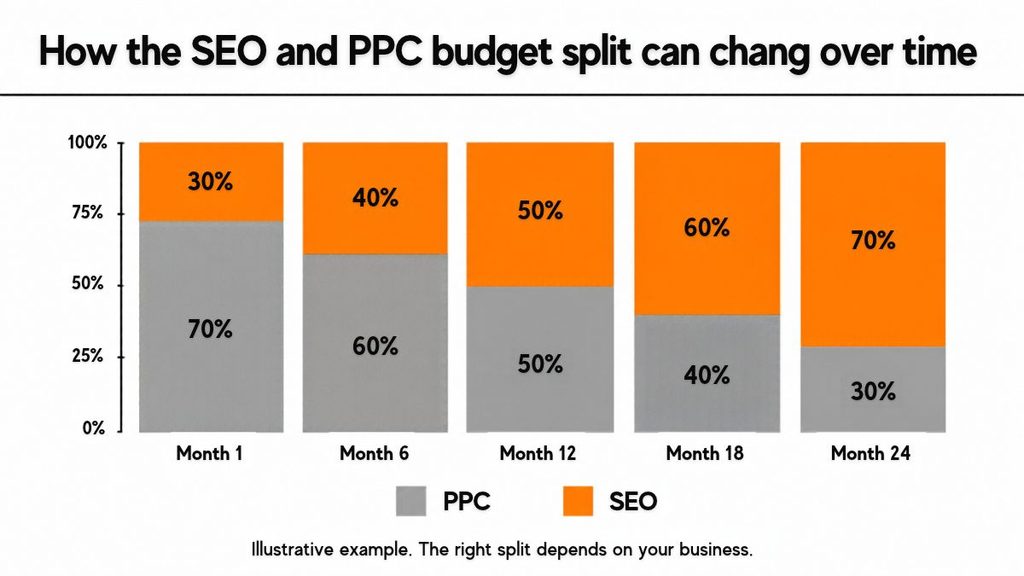
There is no perfect ratio, but these starting points reflect what we typically see work. Treat them as a first draft, then adjust based on your own results.
| Your situation | Suggested starting split | Why |
|---|---|---|
| New website or new market | 70% PPC, 30% SEO | You need leads now while organic visibility builds |
| Established site, steady leads | 50% PPC, 50% SEO | Balance today’s enquiries with long-term growth |
| Strong organic rankings already | 30% PPC, 70% SEO | Protect and grow rankings, use PPC to fill gaps |
| Very competitive, expensive clicks | 40% PPC, 60% SEO | Paid traffic is costly, so organic gains pay back more |
| Short campaign or launch | Mostly PPC | SEO cannot respond quickly enough to a fixed date |
Review the split every quarter. The question to ask is simple: where did our best enquiries come from, and what did each one cost?
How the mix changes by industry and business type
The principles stay the same, but the way SEO and PPC work together looks quite different depending on what you sell and how people buy it.
| Business type | How PPC typically helps | How SEO typically helps |
|---|---|---|
| Online shops selling products | Google Shopping ads show the product, image and price before the click | Category and product pages capture searches across a large range |
| Service businesses | Brings enquiries quickly for your most profitable services | Service pages and expert content build trust before someone gets in touch |
| B2B with long sales cycles | LinkedIn ads reach decision makers by job title and company | Guides and comparison content support buyers through months of research |
| Consumer brands | Meta and Instagram ads create demand, search ads capture it | Helpful content and reviews support people comparing options |
| Local businesses | Location targeting puts ads in front of nearby customers | Your Google Business Profile and local SEO help you appear in the map results |
| Urgent needs, such as an emergency plumber | Often the main channel, because people click the first credible result | Supports trust and reviews, and lowers dependence on ads over time |
| Considered purchases, such as a wedding venue or software | Retargeting keeps you visible while people compare | Usually the stronger channel, because people research carefully |
Products vs services. For online shops, PPC is often driven by Google Shopping, which depends on an accurate product feed and healthy profit margins. If a product sells for £20 with a small margin, every click has to be carefully controlled. E-commerce SEO matters at scale, because a shop with hundreds of products can rank for thousands of specific searches that would be too costly to cover with ads. For service businesses, a single enquiry can be worth hundreds or thousands of pounds, so higher click costs can still be profitable. Here, SEO’s biggest role is building the trust that turns a visitor into an enquiry: clear service pages, real expertise and evidence of results.
B2B vs consumer. B2B buyers often involve several people and take months to decide. Search volumes are smaller, so every relevant search matters, and success should be judged on pipeline and revenue rather than lead numbers alone. Consumer purchases tend to be faster, with higher search volumes and more impulse buying, which suits quick PPC testing and social media.
Regulated industries. Financial services, healthcare and legal businesses face extra rules. Google Ads requires verification or certification before some of these businesses can advertise, and certain products cannot be advertised at all. SEO content in these sectors is also held to a higher standard, because Google looks closely at expertise and trustworthiness on topics that affect people’s money or health. In these industries, SEO is often the more reliable long-term channel, with PPC used carefully within the rules.
Why SEO and PPC work better together
When SEO and PPC are managed separately, each team makes decisions with half the picture. When they share information, both channels improve.
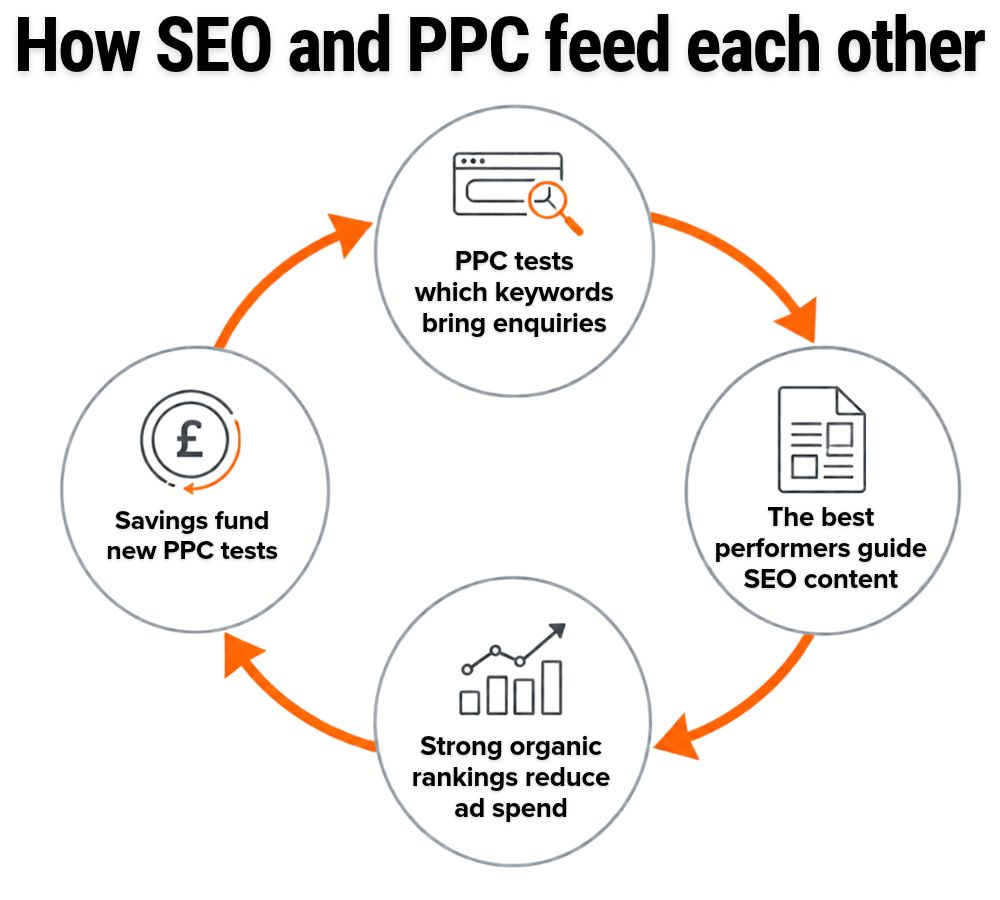
PPC tells SEO which keywords are worth chasing. SEO takes months to show results, so choosing the wrong keywords is costly. Google Ads data shows within weeks which search terms bring enquiries and sales, not just clicks. Those proven terms then guide your keyword research and become the priority for your organic content.
SEO reduces what you spend on PPC. Once you rank well organically for a search term, you can test reducing bids on it and move that budget to terms where you have no organic presence yet.
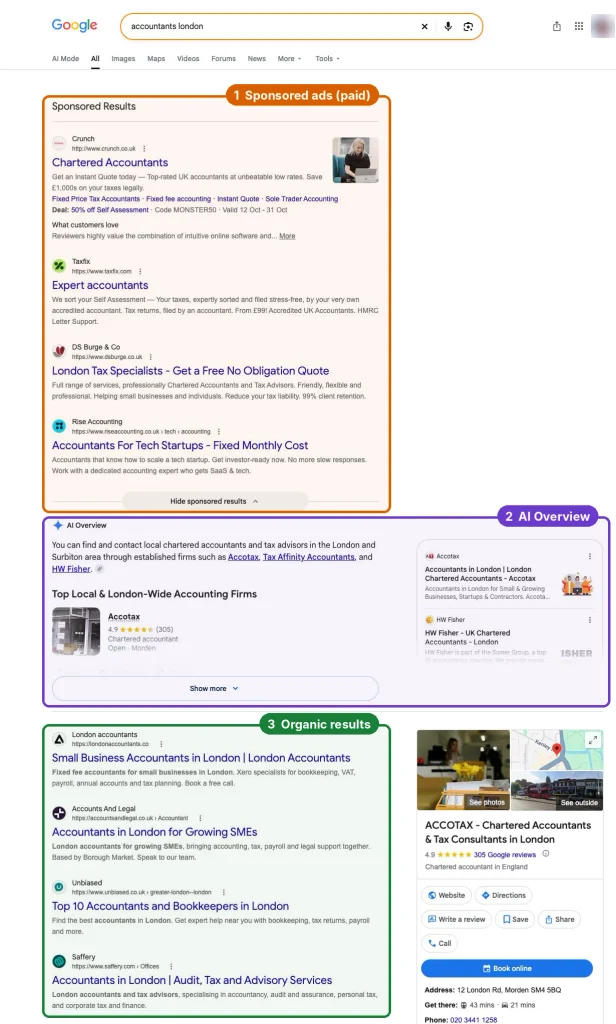
You take up more space on the page. Appearing in both the ads and the organic results for an important search builds credibility, and pushes competitors further down.
Better landing pages help both. Pages that are fast, clear and persuasive improve your Google Ads Quality Score, which can lower your cost per click. The same improvements help organic rankings and conversion rates.
You can bring people back. Many visitors from organic search will not contact you on their first visit. Remarketing ads keep you in front of them while they compare options.
Ad copy testing improves your organic results. PPC lets you find out quickly which headlines and messages people respond to. Those insights can shape your page titles and meta descriptions, which affect how many people click through from organic search.
Real Life Example
How this looks in practice: an accountancy firm in London:
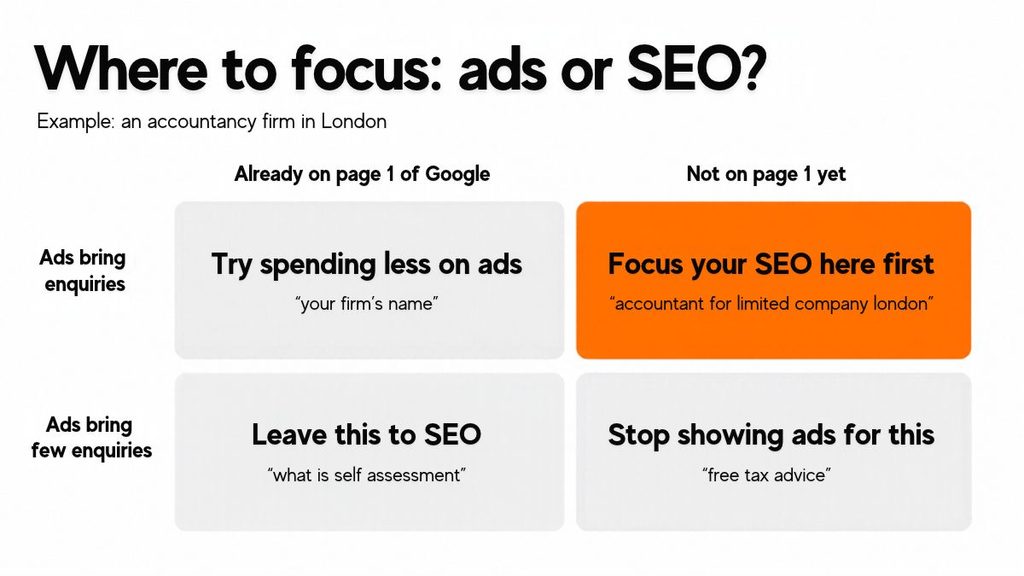
- Google Ads shows what brings enquiries. Within two months, the ads show that people searching “accountant for limited company london” often get in touch, while people searching the broader “accountant london” click but rarely become clients.
- That search becomes the top SEO priority. The firm ranks on page 3 of Google for “accountant for limited company london”, so this is where SEO effort goes first.
- SEO builds the pages to rank for it. A dedicated service page for limited company accounting, a practical guide to limited company accounts and a few relevant links from other websites.
- Ad spend drops as rankings rise. Once the firm reaches page 1 for “accountant for limited company london”, it can spend less on ads for that search.
- The savings fund the next proven search. The budget moves to another search that brings enquiries, such as “contractor accountant london”, and the cycle repeats.
How to run SEO and PPC together in practice
Joining the two up does not need a complicated setup. These are the steps we recommend for most businesses.
- Agree one set of goals. Measure both channels against the same outcomes, such as qualified enquiries or sales, rather than clicks or rankings alone.
- Set up tracking properly. Make sure conversions are recorded consistently in Google Analytics and Google Ads, so you can compare like with like.
- Link Google Ads and Search Console. This unlocks the paid and organic report in Google Ads, which shows where you appear in both results for the same search terms.
- Review search terms together each month. Look at which paid terms convert, then check where you rank organically for them. Strong converters with weak rankings are your next SEO priorities.
- Plan content from proven demand. Use converting PPC terms and common sales questions to decide which pages and articles to create next. A clear content strategy plan keeps this organised.
- Rebalance budget as rankings grow. Where you already rank well organically, try spending less on ads for those searches and check that total enquiries hold steady. Move the savings to searches where you don’t rank yet.
- Keep landing pages and messaging consistent. People who see your ad and then your organic listing should recognise the same offer and tone.
The key is ownership. Whether it is one agency or two teams, someone needs to look at both channels side by side and make the trade-offs.
Should you bid on your own brand name?
This is where SEO and PPC overlap most directly, and it is one of the most common questions we are asked. If you already rank first organically for your company name, why pay for an ad as well?
Sometimes you should not. But there are good reasons to consider it.
Competitors may be bidding on your name. If a rival’s ad appears above your organic listing when someone searches for you, you risk losing people who were already looking for your business. A brand ad keeps the top spot yours.
You control the message. An organic listing shows whatever title and description Google chooses. A brand ad lets you highlight a current offer, a specific service or a booking link, and point people to the most relevant page.
Brand clicks are usually cheap. Because your ad is highly relevant to the search, the cost per click for your own name is often low compared with generic service terms.
It protects you during busy periods. If you are running a campaign, a launch or a TV or social push, brand searches tend to rise. A brand ad makes sure that extra interest lands where you want it.
The case against is simple: if nobody else is bidding on your name and your organic listing is strong, some of those clicks would have come to you anyway. The sensible approach is to test it. Pause brand ads for a few weeks, then compare total enquiries from brand searches, paid and organic combined. If the total holds steady, you may not need them. If it drops, the ads were earning their keep.
Where social media fits
Social media does not directly improve your Google rankings, but it has a real influence on how well SEO and PPC perform. The simplest way to see it: social media creates demand, and search captures it.
People on social media are not looking for you. This is the biggest difference between social and search. On Google, people come to you: they have a need and they type it in. On Instagram, Facebook, LinkedIn or TikTok, people are scrolling. They are catching up with friends, reading industry news or passing time on the train. They are not looking for a solicitor, a new sofa or a marketing agency, and many do not yet know they need one.
That changes how you need to communicate. In search, your ad or page answers a question someone has already asked. On social, you have to stop the scroll and earn attention in a second or two, usually by showing a problem they recognise, a result they want, or something genuinely useful. A search ad that says “Employment Solicitors London, Free Consultation” works because the searcher asked for it. The same message in a social feed is easy to scroll past.
It also changes what success looks like. Most people who see your post or ad will not click, and even fewer will enquire there and then. The real value is often that they remember you. When the need does arise, weeks or months later, they search, and that is where SEO and PPC take over.
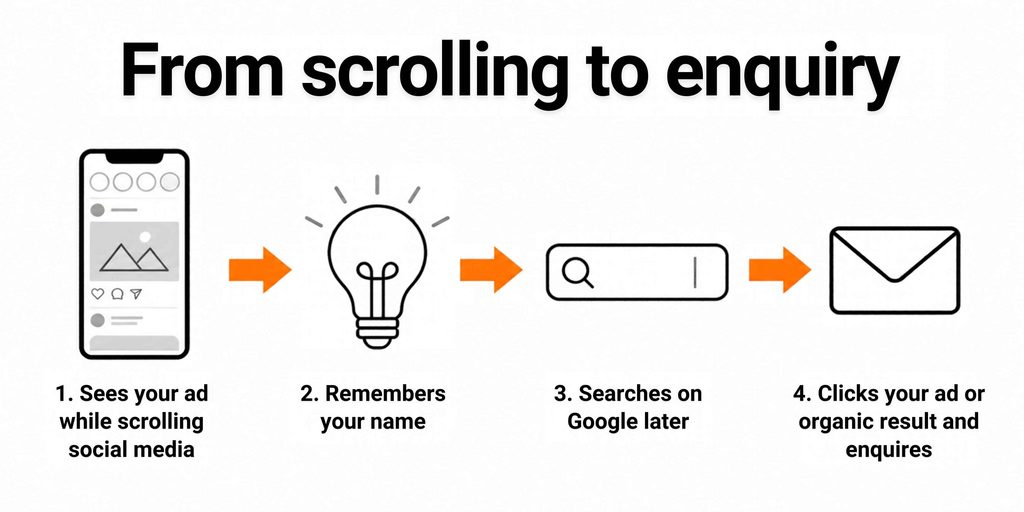
Social creates the searches that SEO and PPC win. Someone who sees your brand on LinkedIn or Instagram may not click straight away. Days later, they search for your name or your service on Google. If your SEO and PPC are in place, you are there to meet them. This is why brand searches often rise during a good social campaign.
Paid social lets you choose who sees you. Google Ads targets what people search for. Paid social targets who people are: their job title, industry, location or interests. On LinkedIn, for example, you can show ads only to marketing managers at companies of a certain size. This makes it a strong way to reach the right people long before they search, so your business is already familiar when they do.
Audiences can be shared across channels. Visitors from organic search or Google Ads can be retargeted on social platforms, and the reverse. This keeps you visible while people compare options, which matters most for considered purchases.
Social content helps your content get found. Sharing articles and guides on social media puts them in front of people who may link to them, mention them or search for them later. Links and mentions are part of what helps a website rank.
Social platforms now appear in search results. Google increasingly shows LinkedIn posts, YouTube videos and Reddit discussions for many searches, and AI tools often draw on them too. An active, credible presence on the right platforms gives you more ways to be found.
The practical takeaway: measure social alongside search, not in isolation. A social campaign that looks quiet on its own may be driving the brand searches that convert through Google.
Common myths and mistakes
The SEO vs PPC debate runs constantly on forums like Reddit and Quora. A few beliefs come up again and again, and they are worth clearing up.
“SEO is free traffic.” Organic clicks have no cost per click, but SEO is not free. It needs skilled time, good content and ongoing technical care. The difference is that the investment keeps paying back after the work is done.
“PPC is wasted money because traffic stops when you stop paying.” Only if you treat it as a tap. Well-run PPC brings in profitable customers and the data it produces keeps its value, because it tells you what your market actually wants.
“PPC is better than SEO in the long run.” For most businesses, no. Costs per click tend to rise as competition grows, while strong organic rankings keep working. PPC is a powerful accelerator, but rarely a full long-term strategy on its own.
“Once we rank, we can stop SEO.” Competitors keep improving, Google keeps changing, and AI search keeps evolving. Rankings that are not maintained tend to slip.
The mistakes we see most often:
- Running both channels with separate teams who never share data.
- Judging PPC on clicks and SEO on rankings, rather than both on enquiries and sales.
- Sending ad traffic to the homepage instead of a page built for that search.
- Bidding on every search term you already rank first for, without testing whether you need to.
- Giving up on SEO after a few months because results have not appeared yet.
How to measure success across both channels
The most useful change most businesses can make is to judge SEO and PPC by the same business results. Clicks, impressions and rankings are helpful signals, but they do not pay the bills.
These are the measures we find most useful when reporting on both channels together:
| Metric | What it tells you | Why it matters |
|---|---|---|
| Cost per lead or sale | What each enquiry or customer costs, by channel | Shows where your next pound is best spent |
| Conversion rate | The share of visitors who enquire or buy | Reveals whether the traffic is right and the page is working |
| Blended cost per lead | Total SEO and PPC spend divided by total leads | Shows whether the combined strategy is getting more efficient |
| Share of leads from organic | How much of your pipeline comes from SEO | Should rise over time as rankings grow |
| Brand vs non-brand searches | Whether people find you by name or by service | Non-brand growth means you are reaching new customers |
| Lead quality | Which channel brings enquiries that become customers | A cheap lead that never converts is not cheap |
Look at the whole journey, not the last click. Many customers touch several channels before they enquire. Someone might click a Google ad, leave, read a blog post found through organic search, and then contact you a week later. Google Analytics 4 uses data-driven attribution by default, which shares credit between the channels involved. It is not perfect, but it gives a fairer picture than crediting only the final click.
Connect marketing data to sales data. If you use a CRM, record where each lead came from and whether it became a customer. Over a few months, this shows which channel brings your most valuable clients, which is often different from which brings the most enquiries.
Be patient with SEO reporting. PPC results can be judged within weeks. SEO needs a longer view, so compare organic performance quarter on quarter and year on year rather than month to month.
A 90-day plan for getting SEO and PPC working together
If you are starting from scratch, or your two channels have been running separately, this is a realistic way to bring them together over three months.
Month 1: Foundations
- Audit your website for technical issues that affect both rankings and ad landing pages, such as slow load times or broken forms.
- Check that conversion tracking works correctly in Google Analytics and Google Ads.
- Link Google Ads with Search Console and Analytics.
- Review current keyword rankings and recent Google Ads search terms side by side.
- Agree the goals and the one or two numbers you will judge success by.
Month 2: Quick wins and testing
- Launch or restructure focused PPC campaigns around your most valuable services.
- Improve the landing pages those campaigns use, so they serve both paid and organic visitors.
- Fix the most important technical SEO issues found in the audit.
- Start testing ad headlines and offers to learn which messages people respond to.
- Identify search terms that convert well in PPC but where you rank poorly organically.
Month 3: Building for the long term
- Create or improve pages and articles for the proven search terms from month 2.
- Use winning ad messages to sharpen page titles and meta descriptions.
- Set up remarketing so organic visitors can be reached again through ads.
- Review results across both channels and agree the budget split for the next quarter.
By the end of 90 days, you should have reliable tracking, a clearer view of which searches bring customers, and an SEO plan built on real evidence rather than guesswork. Organic growth will still be building at this point, which is normal. The aim is a strong, joined-up foundation.
What AI search changes
AI Overviews now appear at the top of many Google searches, and more people are asking tools like ChatGPT for recommendations. This has led some businesses to ask whether SEO is still worth it.
It is, but the focus has shifted, as we explain in our guide to AI in SEO and search trends. AI tools draw their answers from websites they can find, understand and trust. The same foundations that help you rank, such as clear expert content, a technically sound site and a strong reputation across the web, also make you more likely to be mentioned in AI answers.
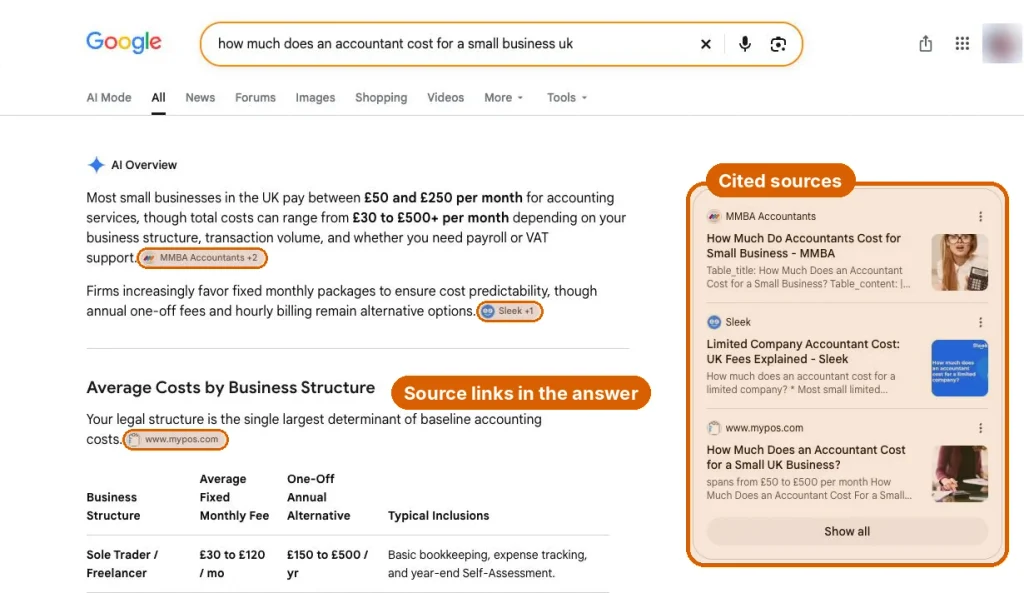
AI is changing paid search too, with ads now able to appear in and around AI-generated answers. For most businesses, this makes a joined-up approach more important, not less. You want to be visible wherever your customers are looking, and to understand which channels actually lead to enquiries.
One partner or two? Choosing who manages SEO and PPC
Many businesses use one agency for SEO and another for PPC, or keep one channel in-house. That can work well, as long as the two sides genuinely share information. The problems start when each team reports in isolation, and nobody owns the overall result.
A single partner managing both has clear advantages: one strategy, one set of data, and budget decisions made with the full picture. If you do work with separate teams, set up a regular joint review and agree shared goals so they pull in the same direction.
Whichever route you choose, these questions help you judge whether someone will manage both channels well:
- How will you measure success? Look for answers about enquiries, sales and cost per lead, not just traffic and rankings.
- How will PPC data inform the SEO work, and the reverse? A good partner should explain this clearly and give examples.
- Who owns the tracking setup? Accurate conversion tracking underpins every decision. It should be checked early.
- What will reporting look like? You should get a clear view of both channels together, with plain English explanations and recommended next steps.
- Who owns the accounts? Your Google Ads account, Analytics and Search Console should belong to your business, so you keep your data whatever happens.
- What happens in the first 90 days? A clear plan shows they have thought about your business, not just a standard package.
Frequently asked questions
Is SEO or PPC better for a long-term strategy? SEO usually delivers more lasting value, because rankings keep bringing in traffic without a cost per click. PPC is better for speed, testing and filling gaps while SEO builds.
Can you do SEO and PPC at the same time? Yes, and it is usually the most effective approach. Running both lets each channel learn from the other and gives you more visibility for your most important searches.
Does running PPC help my organic rankings? Not directly. Paying for ads does not change how Google ranks your organic pages. The benefit is indirect: PPC data shows you which keywords and messages work, which helps you make better SEO decisions.
How long does SEO take compared with PPC? PPC can bring traffic within days of launching. SEO typically takes several months to show meaningful growth, depending on your website, competition and how much work is needed.
Is SEO dead now with AI? No. AI search tools rely on well-structured, trustworthy websites to form their answers. Good SEO is now part of how you get mentioned in AI results as well as ranking in Google.
Does social media help SEO? Not directly. Likes and shares are not a Google ranking factor. But social media builds awareness, which leads to more brand searches, links and mentions, and those do support SEO.
How much should I spend on SEO compared with PPC? It depends on how quickly you need results and how strong your organic visibility already is. Newer websites often lean towards PPC at first, then shift budget towards SEO as rankings grow.
Make SEO and PPC one strategy, not two budgets
SEO and PPC are not rivals. PPC gives you speed, control and fast feedback. SEO gives you lasting visibility and a lower cost per lead over time. Used together, each one makes the other more effective.
At Aksel Digital, we manage SEO and Google Ads side by side for established businesses in London and across the UK. That means one strategy, shared data and budget decisions based on what actually brings in enquiries. You can see the results in our case studies.
If you would like to know how your current mix of SEO and PPC is performing, get in touch for a straightforward review of where your budget could work harder.