
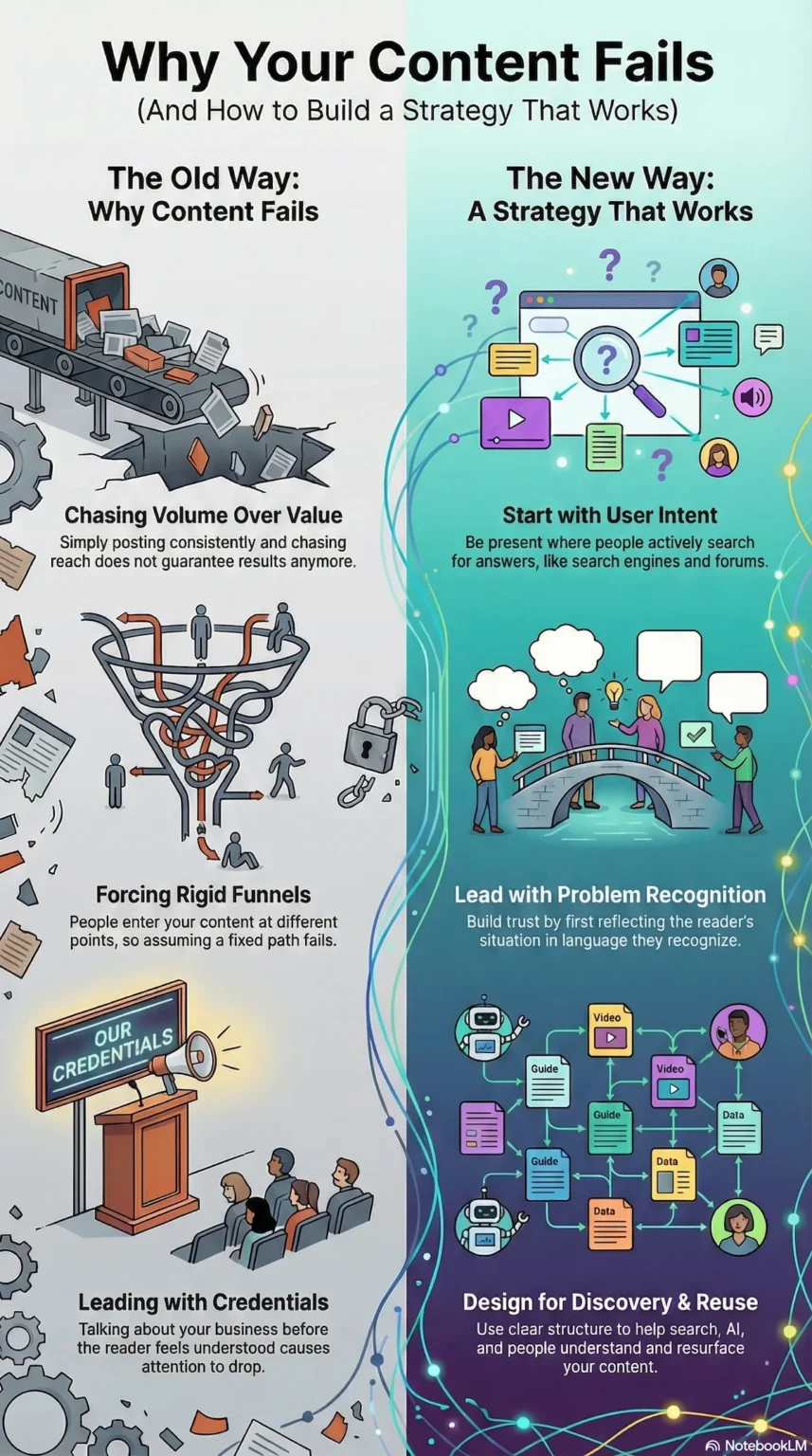
The old way of creating content is no longer working.
Posting consistently, chasing reach, or blindly following funnels doesn’t guarantee growth anymore. Many businesses are producing more content than ever, yet seeing very little return.
What works now is a shift in content strategy, how content is designed, positioned, and structured for real people, and increasingly, for AI systems that shape how information is discovered.
Below are the content strategy principles that are genuinely working today, and why they matter.
1. Start Where People Actually Search for Answers
Content is no longer discovered only through social feeds.
Increasingly, people research solutions through:
- Google and search engines
- AI tools such as ChatGPT
- YouTube tutorials
- Community platforms like Reddit
If your content doesn’t exist in places that search engines and AI tools can understand and reference, you risk being invisible at the exact moment people are looking for help.
This is where AI-aware content strategy matters.
The goal isn’t to be everywhere.
It’s to be present where answers are actively being sought.
2. Think in Messages, Not Funnels
Funnels assume people move step by step.
In reality, someone might:
- Land on your website ready to make a decision
- Discover you through a single blog post
- Read one page and leave or convert
If your content only works when consumed in a specific order, you lose people.
A stronger approach is to think in messages:
- What does someone need to understand right now?
- What belief needs correcting?
- What confusion needs clearing?
Every piece of content should stand on its own and still make sense.
3. Lead With Problem Match, Not Credentials
Most content starts in the wrong place.
It opens with experience, services, or achievements, before the reader feels understood.
Problem-led content mirrors the reader’s situation in their own language. When someone thinks “yes, that’s exactly it”, attention follows naturally.
Before explaining solutions, your content should show:
- You understand the problem
- You recognise the frustration behind it
- You are speaking in their words, not industry jargon
Without problem match, even good advice gets ignored.
4. Fix the Leaks Before You Add More
Most people focus on adding more content, more tools, more platforms.
But if the strategy underneath is leaking, nothing you add will hold.
This is why so many content strategies feel busy but ineffective.
The issue is rarely effort. Often, it’s structure.
Leaks usually appear when:
- The message isn’t clear enough to hold attention
- The positioning is too broad to retain the right audience
- The content isn’t structured to be reused by search engines or AI
When these foundations aren’t in place, increasing output doesn’t compound results. It simply increases activity.
Before scaling content, it’s worth asking whether the system underneath can actually support it.
5. Be Clear About What You Do and Who It’s For
Clear positioning makes content stronger.
A simple structure works best:
What you do – for who
For example:
- SEO strategy for service-based founders
- Content marketing for growing e-commerce brands
Specificity creates relevance.
It helps the right people recognise themselves, and everyone else move on.
If someone has to ask “is this for me?”, the positioning is still too broad.
6. Design Content to Be Reused and Resurfaced
Modern content shouldn’t live once and disappear.
A strong content strategy considers:
- How pages support one another
- How content can be referenced by AI
- How ideas connect across blog posts, services, and FAQs
This is where SEO, internal linking, and structure matter.
Content that is clearly written, well organised, and semantically connected is more likely to rank, be reused, and be trusted over time.
7. Let Personality and Perspective Do the Work
Trust isn’t built through polish.
It’s built through clarity of thinking and perspective.
People respond to:
- How you reason
- What you’ve learned
- What didn’t work before it did
Content that explains why something matters is often more persuasive than content that simply lists tips.
You don’t need to be everywhere.
You need to be recognisable.
8. Prioritise Quality Over Frequency
Posting more does not automatically lead to better results.
Algorithms respond to engagement, not volume.
People respond to usefulness, not consistency alone.
One well-considered piece of content that holds attention will often outperform frequent low-impact posts.
Consistency matters, but consistency of value.
How to Build a Content Strategy That Actually Holds
Most content fails quietly, not dramatically.
Not because the ideas are bad, but because the structure underneath isn’t designed to support long-term visibility, trust, and growth.
A content strategy that actually works focuses on:
- Clear, problem-led messaging
- Specific positioning
- Content structured for search, AI, and people
The goal isn’t to say more.
It’s to build a content strategy that can actually hold what you put into it.
Pro Tip: Learn more about crafting SEO-optimised blog posts in our guide: How to Write a Blog Post.